
Table of Contents
Comparative lead-in: why the choice matters on the ground
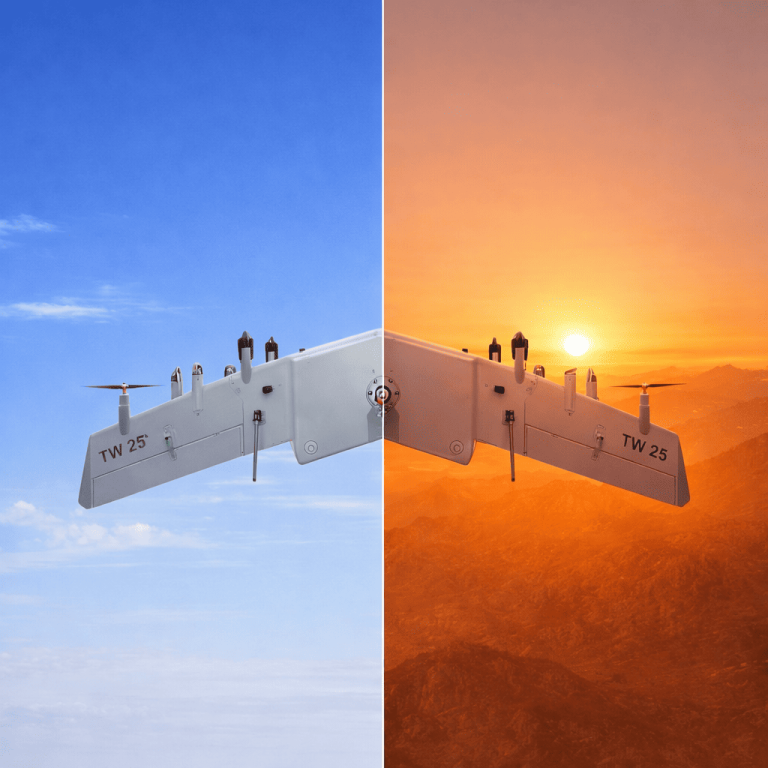
Field teams and engineers judge systems by two things: what they do and how reliably they do it. A loitering weapon guidance stack built for a ruggedized quadcopter favors hover, pinpoint aim, and close-range engagement. A fixed-wing VTOL tilts toward endurance, range, and faster transit. Both types show up in real operations — notably in Ukraine since 2022 — and both bring different requirements for autopilot, GNSS, and payload interfaces. For a straight comparison of platforms and mission fit, consider how a vtol fixed wing drone performs in transit versus a dedicated quadcopter in hover and target acquisition.

Core architecture differences
At the heart of each system is a navigation stack and mission computer. Quadcopter builds center on attitude control, ESC drivers, and high-rate IMU data to hold position and aim a warhead. Fixed-wing VTOL architectures add wing-borne lift, separate propulsive modes, and a transition controller in the flight control unit. That transition controller demands a more robust RTOS and additional sensor fusion logic. Expect different power distribution and cooling needs too — fixed-wing climbs trade battery load for efficient cruise; quadcopters burn energy keeping station.
Guidance and sensor trade-offs
Guidance is where mission intent defines hardware. If you need long loiter time and wide-area search, fixed-wing platforms win because of better glide ratios and efficient cruise — see how vtol uav fixed wing variants extend mission time without a heavy battery penalty. If you need low-speed targeting and downward sensors, the quadcopter can hang and track a spot for extended engagement. Autopilot tuning, GNSS integrity checks, and optical stabilization differ. Quads prioritize gimbaled EO/IR with fast slew; fixed-wing designs favor wide-FOV sensors and scanning algorithms.

Durability, maintenance, and field life
Ruggedized means replaceable arms, sealed connectors, and components that survive rough landings. Quadcopter frames usually allow rapid field swaps — motors and ESCs are modular. Fixed-wing VTOLs require hinge and transition linkage checks and more complex control surface alignment. Parts inventory changes: you’ll carry spare props and ESCs for a quad, but control link spares and servo calibrators for VTOL. Expect different mean-time-between-failures profiles and maintenance cycles — plan logistics accordingly.
Software patterns and mission safety
Guidance software needs clear failsafe behavior. Loitering weapons add a layer of mission logic: target detection, positive identification, engage logic, and end-of-mission return or self-neutralization. Implement conservative engagement flags and monitor GNSS health — a degraded fix should force a safe-state. Data links need secure handshakes and low-latency streams for live targeting. Also, encryption and integrity checks are not optional; they are baseline.
Operational trade study — quick checklist
Use this checklist to match a platform to the mission:
- Range vs. loiter time: fixed-wing gains cruise efficiency; quadcopter gives station time.
- Terminal accuracy: quadcopters offer finer hovering control for small targets.
- Logistics footprint: quads are easier to repair in the field; VTOLs need specific tooling.
- Sensors and payload mass: verify gimbal capacity and center-of-gravity limits.
Common mistakes teams make — practical notes
Teams often overspec batteries for hover without checking thermal limits. Others forget transition tuning on VTOLs and accept oscillations as “normal” — they’re not. Overloading payload bays without recalibrating the autopilot ruins handling. Keep test flights simple: verify GNSS lock, run a motor-spin test, then a short hover or transition. — Log everything. Small notes save big headaches later.

Advisory close: three golden rules for platform selection
1) Match platform endurance to mission profile. If patrol radius and loiter dominate, prefer fixed-wing VTOL for better energy per kilometer; if pinpoint dwell and vertical descent matter, pick a rugged quadcopter. 2) Prioritize modular repairability in the field. Parts you can swap quickly reduce downtime and mission risk. 3) Enforce strict navigation and engagement fail-safes: GNSS health checks, secure datalinks, and an immutable safe-state override.
These are no-nonsense metrics to guide procurement and field setup. For practical parts, platform comparisons, and up-to-date platform reviews, learn what works from operators and documented exercises — and consult resources like Military Hub. — Final note: stay rigorous, keep spares, and test in realistic conditions.
