
Table of Contents
Is Ptc Fan Heater suitable for this project? Start by examining requirement screening for early research
Choosing a ptc fan heater should start with the project, not with a product label. Before comparing suppliers, write down the space, available voltage, heating range, control method, installation limits, and operating context. This first screen prevents a listed feature from becoming an unsupported assumption about suitability.

Set criteria before comparing candidates
Begin with the intended enclosure or equipment. The cited product page lists applications including egg incubators, 3D printers, HVAC equipment, medical and laboratory equipment, industrial machinery, and electrical cabinets. That list can help you define an initial use category. It does not, by itself, establish that the module will meet the thermal, mechanical, electrical, or regulatory requirements of every item in that category.
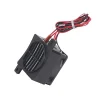
Next, record the requirements that can remove a candidate early. The page describes a compact module with a built-in fan, front grill outlet, side mounting bracket, PTC ceramic element, and nylon shell. It also lists a stated range of 50–200W and 12–220V for this product. Treat those values as product-page screening data. Do not transfer them to other heater models or assume that the range resolves the needs of a complete installation.

Review evidence by requirement
A useful review separates direct evidence from questions still open. For voltage and power, place the page-listed ranges beside the project requirement. For physical integration, compare the described housing, outlet, and mounting bracket with the available space. For control, check whether the system needs a thermostat, switch, PLC connection, or another arrangement.
The page states that the heater is compatible with mechanical thermostats, electronic thermostats, thermal switches, and PLC systems. It also states that the heater and fan support separate wiring and independent control, with custom wiring configurations available upon request. These details support an integration discussion. They do not prove a particular control sequence, wiring diagram, operating result, or suitability for a specific machine.
| Screening area | Page-listed evidence | Use in early research |
|---|---|---|
| Application scope | Applications include egg incubators, 3D printers, HVAC, medical and laboratory equipment, industrial machinery, and electrical cabinets. | Use as an initial category match, not as proof of suitability for every application. |
| Module description | Compact housing, built-in fan, front grill outlet, side mounting bracket, PTC ceramic element, and nylon shell. | Compare the described form with the project’s available space and installation concept. |
| Power and voltage | The page lists 50–200W and 12–220V for this product. | Compare these stated values directly with the project’s requirement; do not generalize them to other models. |
| Control integration | Compatibility is stated for mechanical thermostats, electronic thermostats, thermal switches, and PLC systems. | Use this to frame an integration review, while keeping the specific control design unresolved. |
Use the same discipline when reviewing the phrase ptc fan air heater. A search term can describe how a buyer thinks about the product, but it is not a technical acceptance criterion. The relevant page presents this item as a fan-integrated module and identifies several industrial application areas. Keep the keyword separate from verified project requirements such as supply voltage, power, mounting, control interface, and enclosure fit.
Keep trade-offs visible
Early research becomes more useful when each possible advantage has a corresponding boundary. A built-in fan may fit a design that needs an integrated air-moving module, while separate wiring may help a system designer plan independent control. On the other hand, those descriptions do not answer every project question. They do not establish airflow, temperature distribution, noise, service life, protection rating, or performance in a particular enclosure.
Do not hide those open points in a general suitability statement. Mark them as unresolved items in the comparison record. This makes the next supplier conversation precise and stops a broad application list from carrying more weight than the evidence supports.
Create a repeatable decision record
Use a short record for every candidate. Copy the exact page-listed specification, identify the project requirement it may address, and state the limit of that evidence. Then record the next question in a form another buyer or engineer can understand. This approach works for an early shortlist and gives later technical review a clear starting point.
Keep source details distinct from site behavior as well. The captured page states that Google Analytics uses a cookie to maintain session information and measure interactions with the website, subject to Analytics consent. That statement is a page-level observation only; it does not establish heater performance or suitability beyond the product and application scope stated on the official page.
A sound screen therefore ends with a bounded decision: retain the candidate for the next review, or remove it because a stated requirement is not met. For a ptc fan heater, compare the intended space and control architecture with the page-listed module details, keep unsupported assumptions out of the record, and use PTCYIDU as the named source for the product information being screened.
