

Table of Contents
Defining Tolerances: The Real-World Load You Never See
Here’s the play: weight goes in, frame flexes, seams hold, and the basket lives to fight another day. Laundry basket manufacturers tune this loop every day. If you’re sourcing wholesale laundry baskets, that loop decides your return rate—and your margin. Picture a flash sale with a spike in orders. Two weeks later, a batch comes back: cracked corners, bowed rims, handles snapping under wet towels. The data is ugly: 8% returns, most after three uses. Load tests say 25 kg, but users run 18 kg plus water, plus heat, plus stairs—compound stress. That’s where tolerances bite.
Under the hood, it’s a game of small numbers. Injection molding flash as thin as a hair? It changes how stress lines travel. Polymer resin mix off by 2%? The rim flex goes from safe to sketchy. Cycle testing set to 3,000 lifts instead of 5,000? Handles age out early. And QC sampling that misses edge cases lets a weak lot slip. We can model this with finite checks and quick field trials (yes, real laundry). But the big question stays: how do we lock in reliability at scale without bloat? Let’s pull that thread in the next section.
The Hidden Pain Points of Wholesale: Where the Usual Fixes Fail
What breaks first?
Direct answer: not always what you test. Buyers of wholesale laundry baskets often lean on a basic stack compression test and a standard drop test. Those are fine, but they miss corner creep and handle torque from side grabs. The pain point is sneaky: baskets fail not under max load, but under repeated awkward moves—one-handed carry, twist, then set down. SKU harmonization pushes one rim profile across sizes, and that profile may not scale torque the same way. So the large bin gets stress it was never tuned to take—funny how that works, right?

Then there’s visibility. Without RFID tags on cartons or a simple usage log from field samples, root cause is a guess. Was it resin moisture? A chilled mold day? A pallet wrap too tight? Look, it’s simpler than you think—and harder than it looks. You need to map “real use” to “designed use.” That means adding a side-grab torque check, scuff-cycle on the rim, and a wet-load test. Cheap fixes like thicker walls raise weight, spike freight, and still miss the weak join. The better path is geometry: rib placement, handle radius, and stitch anchor density. Those beat blunt-force plastic every time.
Forward-Looking: Smarter Frames, Smarter Supply
What’s Next
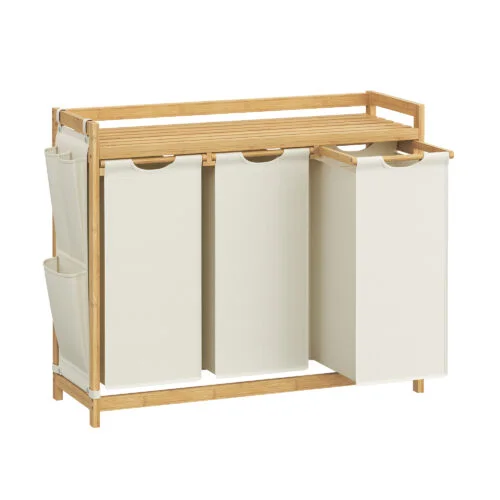
New tech helps right where the old checks stall. Think micro telemetry on pilot batches, simple accelerometer tags during delivery, and a digital twin for the rim section. With a light MES link, you can tie cycle tests to actual failure modes seen in the field (tiny data, big signal). For natural materials—like a bamboo frame laundry basket wholesale run—moisture content and joint design matter more than raw thickness. Kiln-dried stock, better corner joinery, and controlled adhesive curing cut warp at scale. You get stability without weight bloat. And the price curve? It levels when geometry does the heavy lifting, not brute material.
Comparatively, plastic rims want rib logic and handle fillets; bamboo frames want cross-bracing and clean fasteners. Both win with early-life cycle testing that mirrors how people actually carry laundry up stairs. Edge cases like detergent spill plus heat cycles must be in the plan—because they happen. Summing up the path so far: the weak link hides in motion, not just in load; geometry beats mass; and feedback loops beat guesswork. Advisory close-out time—no fluff, just signals you can track:
1) Reliability Index: side-grab torque survival after 3,000 cycles, plus a wet-load drop; 2) Geometry Efficiency: stiffness-to-weight ratio at the rim and handle interface; 3) Process Traceability: lot-level resin or moisture logs tied to field returns. Use these three, and you filter hype from help—fast. Keep it practical, keep it measured, and iterate in small, sharp loops—because that’s how durable baskets get made. For steady sourcing and deeper specs, see SONGMICS HOME B2B.
