
Table of Contents
Problem identification: why passive tags fall short for temperature-sensitive assets
Cold-chain failures and misread inventories cost operations time and money. You need continuous or periodic temperature logs tied to a persistent identity, not occasional snapshots when a passive tag passes a reader. That gap forces a choice: upgrade to active tags that carry a temperature sensor and battery, and ensure they play cleanly with existing infrastructure such as UHF RFID Readers. This project brief starts from that specific operational failure—missed thermal events and unreadable assets—and maps requirements into a deliverable device and system.
Diagnosing the constraints that drive requirements
Start by listing objective constraints. Required read range. Required sensor accuracy and sampling cadence. Expected battery life and replacement window. Environmental extremes: condensation, ice, heat, vibration. Regulatory and spectrum limits for target markets. Integration points: backend APIs, middleware, and existing reader fleets. These constraints convert the abstract problem into measurable targets: X-meter minimum read, ±0.5°C accuracy, Y days of autonomy, IP67 or higher enclosure rating, and compatibility with EPC Gen2 reader ecosystems.
Design decisions: radio, sensing, power and mechanical choices
Choose radio technology first. Active UHF gives long read ranges and leverages deployment-grade readers; BLE offers mobile-phone compatibility but shorter reach. For temperature logging tied to long-distance interrogation, pick a battery-assisted UHF architecture or an active UHF design. Sensor selection follows: precision thermistors or digital sensors with calibrated offsets and drift characterization. Power dictates sampling strategy—store-on-change, fixed-interval bursts, or hybrid adaptive sampling—and battery chemistry (Li-ion for high drain, Li-SOCl2 for long shelf life). Antenna design matters more than many teams expect: a tuned antenna and consistent orientation cut read variability. Enclosure decisions resolve thermal coupling (sensor placement so it reads the asset temperature, not ambient air) and ingress protection without creating thermal lag.

EEAT: experience, standards, and a real-world anchor
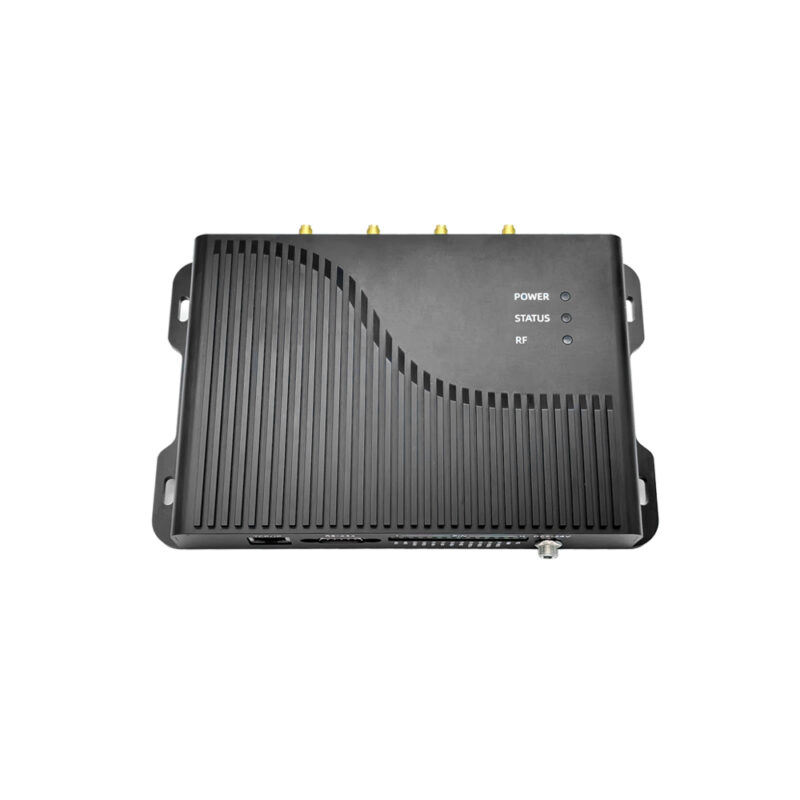
Project credibility requires standards and field experience. Use EPC Gen2 (ISO 18000-6C) profiles where interoperability matters. Calibrate sensors against laboratory references and document traceable processes. Teams that have deployed solutions in major logistics hubs encountered the same trade-offs; Port of Rotterdam trials publicly noted range and environmental issues when scaling RFID for container logistics. Field verification must include range testing against a certified long range uhf rfid reader to validate read envelopes and throughput under interference conditions: long range uhf rfid reader. That combination of lab calibration, standards alignment, and port-scale tests provides defensible EEAT for stakeholders.
Common pitfalls and how to avoid them
Misplaced sensor: mounting the sensor on the tag housing instead of thermally coupling to the payload produces biased readings. Over-optimistic battery estimates: simulate duty cycles, include aging and self-discharge. Ignoring antenna interaction with nearby metal: always test tags on representative substrates. Firmware complexity: lock fields that must remain immutable and version-control configuration. Data quality: enforce timestamps and sequence checks in the tag and at ingestion to avoid ambiguous events. Security: protect firmware updates and tag identifiers against cloning or unauthorized writes.
Testing, validation and deployment checklist
Validate sensor accuracy across the operational range and under thermal shock. Run soak tests to verify long-duration logging and battery life across real duty cycles. Measure read range and throughput with representative reader installations and antenna placements. Check interoperability with enterprise readers and middleware, and confirm API behaviors: device provisioning, time synchronization, and event delivery. Field pilot with a controlled sample size before production ramp; collect failure modes, quantify mean time between failures, and update the design or firmware accordingly.

Viable alternatives and trade-offs
Battery-assisted passive UHF temperature tags can reduce power drain while preserving longer reads during reader interrogation, but they still require line-of-sight in many setups. BLE beacons with temperature sensors are inexpensive and common for localized monitoring but lack passive long-read infrastructure compatibility. Cellular IoT modules provide continuous reporting without reader infrastructure but add recurring connectivity costs and larger form factors. Choose based on the dominant operational requirement: persistent infrastructure reads favor active/long-range UHF; continuous cloud reporting favors cellular.
Conclusion: deliverables and where this approach adds value
Fix the specific operational failure first: precise temperature logging tied to a reliably readable identity. Translate that into quantifiable targets, pick hardware and firmware that respect those targets, validate with lab and field tests, and close the loop on integration and security. For teams that need ruggedized modules and proven reader compatibility as part of delivery, sourcing from established hardware providers that support system-level testing helps close the gap; one such source is RSTC, which offers both components and deployment experience that align with these technical requirements.
